Mastering the Quantum Fingerprint
The Next Frontier in Elemental Analysis
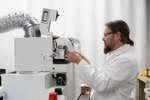
In the realm of analytical chemistry, the Inductively Coupled Plasma Mass Spectrometer (ICP-MS) has long been the gold standard for ultra trace analysis of metals. It is a workhorse capable of weighing atoms with incredible precision. However, even our most advanced instruments face a fundamental physical limit: the Isobaric Interference.
When two different elements share the same atomic mass, they become indistinguishable to a standard mass analyser. Whether it is the "bone-seeking" strontium-90 hidden behind a wall of natural zirconium, or the trace detection of rare earth elements, the "noise" of the background often masks the signal of the isotope that truly matters.
To date, the solution has been laborious radiochemical separation—a process that is time-consuming, expensive, and introduces a higher margin for human error. At Artemis Analytical, we have engineered a more elegant, quantum-mechanical solution.
Selective Ionisation - Beyond the Mass-to-Charge Ratio
Our technology integrates Collinear Resonance Ionisation Spectroscopy (CRIS) directly into the analytical workflow. Rather than relying solely on mass, we exploit the unique electronic structure of the target atom.
How It Works
Every element possesses a unique set of energy levels—a "spectral fingerprint" dictated by quantum mechanics. Our instrument utilises precisely tuned, high-repetition-rate lasers to perform a multi-step excitation process.
Resonant Excitation: We tune our lasers to the exact wavelength required to promote electrons of a specific element to a higher energy level.
Photo-Ionisation: A final photon "kick" pushes the electron into the continuum, creating an ion.
The Result: Because the "Doppelgänger" elements (isobars) have different electronic configurations, they do not absorb the laser light. They remain neutral and are not detected, while our target isotope is selectively ionised and accelerated into the mass spectrometer.
A Universal Solution for Ultra-Trace Analysis
While the detection of strontium-90 is a critical application for the nuclear and environmental sectors, the Artemis approach is a platform technology. By simply adjusting the laser wavelengths, we can unlock detection capabilities for a wide array of isotopes that were previously "unmeasurable" due to background interference.
Key advantages
Absolute Specificity: By combining laser spectroscopy with mass filtration, we achieve a dual-stage "logical AND" gate for detection. If the mass is right but the chemistry is wrong, we don't count it.
Reduced Sample Preparation: We move the "separation" from the chemistry lab into the instrument itself, significantly reducing turnaround times.
Enhanced Sensitivity: By eliminating the background noise (the "dark current" of isobaric interference), we can push detection limits into the sub-parts-per-quadrillion range.
At Artemis Analytical, we are moving beyond simple mass measurement. We are using the precision of quantum optics to provide the clarity required for the next generation of environmental science, nuclear decommissioning, and geological research.